
Gideon Mailer came to the University of Minnesota system from the University of Cambridge, UK. He was the Chair of the History Program at UMD from 2016-2021. From 2008-2012, he was an elected Title A Junior Research Fellow (JRF) of St John’s College, University of Cambridge, where he lectured and supervised in American and Atlantic history and in the history of intellectual thought. Before his Junior Research Fellowship at St. John’s, he took his PhD under Betty Wood (2008), MA, and BA (hons; Double-First Class) from Cambridge.
Gideon Mailer invites students and readers on a journey through the remarkable evolution of liberty, beginning with the ancient Anglo-Scottish constitutional framework and culminating in the establishment of the United States of America. His work illuminates the ideals and struggles that defined the origin and legacy of the American Revolution, from the British Glorious Revolution through the tumultuous years of the Civil War. Through his teaching and writing, Mailer reveals the extraordinary development of freedom and governance, providing insightful perspectives on the challenges and triumphs that contributed to creating "a more perfect union." He endeavors to capture the essence of America's ongoing pursuit of liberty and the sacrifices that have paved the way for it.
Mailer’s research embarks on two parallel tracks, illuminating how historical events have shaped our understanding and representation of moral, religious, philosophical, and scientific ideas – and showcasing why America boldly stands at the forefront of these representations.
The first track encompasses the social, intellectual, constitutional, and religious history of North America and the wider Atlantic World from 1600-1865. Its work highlights the profound influence of the Scottish Enlightenment on the American Revolution and the formation of American federalism. The Scottish Enlightenment served as a beacon – perhaps the beacon - of intellectual inspiration for American founders such as Benjamin Franklin, Judith Sergent Murray, James Madison, Lemuel Haynes, and Thomas Jefferson. Thus, Mailer explores the impactful legacies in America of Scottish luminaries like Francis Hutcheson, the pioneer of sentimental moral theory; Adam Smith, the champion of Free Trade economics; David Hume, the trailblazer of philosophical skepticism; and Thomas Reid, the architect of Common Sense theory.
In a unique dialogue, Mailer intertwines the work of these Enlightenment figures with that of equally significant Scottish and American advocates of Protestant evangelical piety – from Anne Hutchinson to Jonathan Edwards and John Witherspoon to Frederick Douglass. This exploration not only sheds light on their vital contributions to the exceptional trajectory of American freedom. It also highlights their dual contribution to abolitionist ideology and the enduring struggle between liberty and slavery that shaped the period between the American Founding and the US Civil War.
The second track focuses on the contributions of Early American and Indigenous history to Medical Humanities and Memory Studies. It explores how we can represent and compare histories of population loss and survival to provide insights into public health practices and cultural institutions. It aims to achieve this without relativizing or diminishing these histories or manipulating them to fit any political agenda. Through this collective remembrance, we can uncover shared wisdom that fosters healing and connection: whether by identifying ways to commemorate loss without resorting to fatalism or social division, or by examining those histories of loss and survival to uncover clues about the path to biological and evolutionary health.
Selected Recent Books and Publications
Research Track 1
- The Character of Freedom: The Scottish Enlightenment and American Slavery (University Press of Kansas: American Political Thought Series, 2026)

The concept of liberty—so important to the American founding—was significantly informed by Scottish Enlightenment philosophy. That in turn offered potential support for anti-slavery ideology. The Character of Freedom thus explores the possible abolitionist legacies in America of Scottish luminaries like Francis Hutcheson, pioneer of sentimental moral theory; Adam Smith, champion of Free Trade economics; David Hume, trailblazer of philosophical skepticism; and Thomas Reid, architect of Common-Sense philosophy. It uncovers that potential through their interaction with equally significant advocates of Protestant piety. Some founders, however, were also enslavers. What, then, is the actual relationship between the Scottish Enlightenment and racial slavery from the 1740s through the 1840s? Spanning both sides of the Atlantic, white thinkers faced the contradiction between their theories of liberty and slaveholding in their realm. Black Presbyterians were likelier to use Scottish moral philosophy to espouse radical abolitionism, eventually influencing white theorists to adopt bolder agendas. The Character of Freedom explores the intersection of Enlightenment and Evangelical ideas with discussions of slavery in the Atlantic World from the 1740s to the 1840s.
From Glasgow to Philadelphia, Edinburgh to Princeton, and Aberdeen to Virginia, religious and educational institutions founded by Scots contained a mix of Evangelical beliefs and Enlightenment moral philosophies. Educators, clergy, and writers drew upon that mix of beliefs to either support or critique two constitutional models: Britain after the 1707 Act of Union and the United States following the 1776 Declaration of Independence. Each of these models featured its own forms of abolitionism.
By delving into earlier anti-slavery efforts in mainland Scotland, including the involvement of black Christians, the book challenges the commonly held notion that British abolitionism began solely in London during the 1790s. Furthermore, by exploring the impact of Scottish intellectual and religious culture across the Atlantic, it enriches our understanding of a distinct form of American abolitionism that emerged in the wake of the Revolution.
Selected Reviews
“The influence of eighteenth-century Scottish moral philosophers (Francis Hutcheson, Thomas Reid, Adam Smith, and others) on Americans is well known, and that they frequently theorized about slavery. No one, however, has done what Gideon Mailer brilliantly achieves in this book by examining connections between these philosophers (or those they influenced, many of them Presbyterians with evangelical convictions) and their stances on slavery. Differing personal contexts for the leading philosophers themselves, white Scottish Americans in Philadelphia and Princeton, and … Black Presbyterians meant that ‘malleable philosophical ideas’ could be exploited to attack slavery, excuse it, or stake out positions in between. The book is comparative, intellectual, religious, and cultural history at its best.”—Mark Noll, University of Notre Dame, author of America's Book: The Rise and Decline of a Bible Civilization, 1794-1911
“In The Character of Freedom, Gideon Mailer takes up one of the biggest historical questions of our moment: did the Enlightenment ultimately contribute to the rise of abolitionism or help justify chattel slavery in the New World? His original answer draws us deep into eighteenth-century Scottish thought and then shows us the mutability of ideas, especially in the hands of Black Presbyterians whom Mailer effectively restores to intellectual history.”—Sophia Rosenfeld, University of Pennsylvania, author of The Age of Choice: A History of Freedom in Modern Life
“This is a work of immense richness and subtlety, tracing the largely unrealized potential of a Scottish language of universal ethical sensibility and the various compromises, silences and evasions which substantially qualified its impact on white discourse around American slavery. By a further irony, Mailer recognizes how Scots Calvinist ideas of total human depravity offered an alternative rationale for liberty. However, it was only among Black American Presbyterians that ideology aligned uncomplicatedly with material interests.”—Colin Kidd, University of St Andrews, editor and translator of Volney: The Ruins and Catechism of Natural Law
“From Scottish lecture halls to Virginia plantations and beyond, The Character of Freedom traces how religious responses to the Scottish Enlightenment crossed the Atlantic and shaped American responses to slavery. Gideon Mailer offers essential insights into both the history of abolitionism and the very intellectual roots of American liberty.”—Ben Wright, University of Texas at Dallas, author of Bonds of Salvation: How Christianity Inspired and Limited American Abolitionism
“In this wide-ranging and incisive book, Gideon Mailer illuminates the critical importance of the Scottish Atlantic in global battles over slavery and freedom during the Age of Abolition. From the classic figures of the Scottish Enlightenment whose work became central to rising antislavery struggles to Black runaways who made ramifying freedom claims in Scottish courts, The Character of Freedom makes a compelling case for Scotland as a foundational part of Atlantic abolition. Deeply researched and full of compelling insights on race, religion and trans-Atlantic reform, Mailer’s text is essential reading for anyone interested in the rise of the antislavery movement in the 18th and 19th century world.”—Richard S. Newman, Rochester Institute of Technology, author of Abolitionism: A Very Short Introduction
“Gideon Mailer’s The Character of Freedom offers a compelling and original examination of how Scottish Enlightenment thought shaped early American debates over slavery and freedom. His transatlantic perspective and the meticulous attention he pays to both black and white Presbyterians illuminate the profound tensions between moral philosophy and bondage. It is an indispensable contribution to intellectual history and the origins of abolitionist thought.”—Judith Ridner, Mississippi State University, author of The Scots Irish of Early Pennsylvania: A Varied People
“An important, wide-ranging, and contextually sensitive work of intellectual history documenting the complex intersections between Scottish Enlightenment moral philosophy, Presbyterian religion, race, American abolitionism, and slave holding. Gideon Mailer’s story moves from Scotland, the locus of both Francis Hutcheson’s moral philosophy and the runaway slave Joseph Knight’s contesting of slave laws, through John Witherspoon and Princeton and most remarkably to Samuel Cornish’s Freedom’s Journal and ‘African America.’ Throughout Mailer emphasizes the ways in which the persistent ambiguities and tensions of the Scottish Enlightenment around religion, race, and slavery—above all in the universality of the moral sense—served as a touchstone for complex, flexible, and diametrically opposed responses.”—Aaron Garrett, Boston University, Editor Scottish Philosophy in the Eighteenth Century
*****
- John Witherspoon’s American Revolution (Chapel Hill: University of North Carolina Press, Omohundro Institute of Early American History and Culture, 2017). Second edition (paperback) published in February 2019.
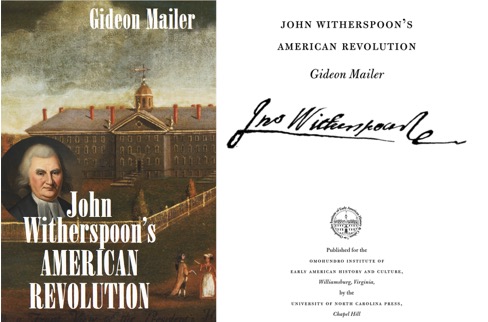
On the relationship between piety, enlightenment thought, and political unionism from the colonial era through the American Revolution. At the forefront stands John Witherspoon, the only Christian minister to sign the American Declaration of Independence and a pivotal figure among the Founding Fathers.
John Witherspoon’s American Revolution continues to stimulate coverage and commentary in various media. Its discussion of the political theology of American constitutional architect James Madison, who Witherspoon mentored, provides a bridge to other published essays, future work on the relationship between Baptists and Presbyterians in early national Virginia, and public history work and documentaries on religion and the American Founding.
Selected Reviews
“…a compelling case…a lens through which to more accurately gauge the interplay of religious conflict and Enlightenment philosophy in the founding of the United States.” --American Historical Review
“A landmark in Scottish-American historiography.” --Eighteenth-Century Scotland
“…this is intellectual and cultural history of a high order…a reminder that the eighteenth century in general, and the Revolutionary era in particular, saw a balancing act between twin impulses of the time, one philosophical, another religious—and both political.” --Reviews in American History
“Mailer’s tour de force of research has produced a cornucopia of insights into a key but underappreciated leader of the eighteenth-century Atlantic world...” --Mark A. Noll, University of Notre Dame
“Mailer explores the rich philosophical origins of the Revolutionary War, American education, and the United States’s distinctive civil religion….This work transforms our understanding of the only minister to sign the Declaration of Independence and his most influential student, James Madison.” --Kate Carté Engel, Southern Methodist University
“…Mailer uncovers a specifically Scots Presbyterian dimension to the political and moral culture of Revolutionary America.” --Ned Landsman, State University of New York, Stony Brook
“...Mailer provides new clarity on the relation of religion and politics at the founding..." --Journal of Church and State
“…In this thoroughly researched and sophisticated book, Mailer cuts against the grain of recent scholarship...” -- First Things: American's Most Influential Journal on Religion and Public Life
“Gideon Mailer has given us a fantastic study that situates Witherspoon properly within the ranks of Reformed orthodoxy…an invaluable resource for helping understand…the intellectual climate of the Scottish Enlightenment and the American founding…[as well as] the principles of government which shaped our nation’s political character.” -- American Reformer, June 2022
“This is early American intellectual history at its best..” --New Jersey Studies
“It is no mean feat to provide a significant contribution to the scholarly conversation on the American Revolution.” -- Journal of Presbyterian History
“Mailer writes eloquently and clearly concerning these complex interactions between evangelical devotion and Scottish enlightenment philosophy, and in doing so, illuminates the character, philosophy, and piety of his subject...Throughout, Mailer's scholarship, prose, and organization are exemplary.” -- Journal of Scottish Philosophy
“This thoroughly researched work is best suited for scholars of Enlightenment history and the American Revolution.” --Library Journal
“Thoroughly researched. . . . [A] detailed investigation. Recommended.” --Choice
“…Highly Recommended...” --Douglas Sweeney, Sweeney’s Booknotes, Jonathan Edwards Center
*****
- “Thomas Jefferson, John Witherspoon, and the Problem of Slavery in the Declaration of Independence,” Journal of Scottish Thought 14, no. 1 (May 2025): 78-93


This research article shows how Scottish Enlightenment discussions of historical advancement influenced Thomas Jefferson. Ironically, they complemented his tendency to connect Scottishness with foreignness. That connection underscored the common cause of American independence, including concerning institutions such as racial slavery. Slavery was said to have remained in the American union as an unfortunate but also unmovable historical legacy of earlier Anglo-Scottish corruption. As a regrettable remnant of their historical mistreatment, enslaved people had become akin to a foreign entity. Consequently, according to Jefferson, they could not necessarily be trusted to support American civic norms after their immediate emancipation.
The article shows how that characterization contributed to the broader intellectual context in which John Witherspoon lived and worked, including his role as a Scottish-born signatory to Jefferson’s Declaration of Independence. Witherspoon promoted greater anti-slavery sentiment than Jefferson and was relatively progressive in his support for biracial higher education. Yet ambiguities and tensions remained in his approach to racial slavery, including his support for gradual rather than immediate emancipation. Witherspoon hoped his signature on the Declaration of Independence would help uncouple Scottishness from Patriot discussions of historically rooted foreign danger. However, it also appeared at the foot of a document that described immediate emancipation as a security threat to American civic life.
*****
- “The Not So Puritan Origins of the American Self,” Reviews in American History, 50. 1, (March 2022): 7-15.

*****
- “Presbyterian Confederal Ideology from the Imperial British Constitution to the new United States,” in Peter C. Messer and William T. Harrison, eds, Revolution as Reformation: Protestant Faith in the Age of Revolutions (Tuscaloosa: University of Alabama Press, 2021).

On the history of multilayered forms of representation in Scottish Calvinist theological systems and their influence on theories of confederation and federation in colonial America and during the American Founding.
*****
- “Freedom from spiritual slavery, but from civil too: Jonathan Edwards, the Scottish Enlightenment, and American Slavery,” in Daniel N. Gullotta and John T. Lowe, eds. Jonathan Edwards within the Enlightenment: Controversy, Experience, and Thought (The Jonathan Edwards Center at Yale University: 2020)

On the tension between enlightenment and evangelicalism in the moral philosophy of America’s most famous theologian, and the impact of that tension on Edwards’s approach to racial slavery in the American colonies.
Research Track 2
- Remembering Histories of Trauma: North American Genocide and the Holocaust in Public Memory (New York and London: Bloomsbury Academic Press, April 2022).

Remembering Histories of Trauma compares and links public representations of the Holocaust and North American genocide to show how they have often obscured the events of which they are supposed to be the reminder. Using source material from both sides of the Atlantic, it examines the differences between ancestral experiences of genocide and the representation of those histories in public sites in the United States, Canada, and Europe. Challenging the ways public bodies have used those histories to frame the cultural and political identity of regions, states, and nations, it considers the effects of those representations on internal group memory, external public memory, and cultural assimilation.
Selected Reviews
“This is an ambitious, generous, and much needed book. It addresses anxieties that have made it hard to see links between the experience and representation of anti-Jewish and anti-indigenous genocides. More impressive still, it does so without overly generalizing the experiences and sensibilities of indigenous people or Jews themselves or reducing them solely to victimhood. It should foster many productive and critical discussions. I hope it will be widely read.”
-- Jonathan Boyarin, Diann G. and Thomas A. Mann Professor, Cornell University, USA
“With great reflection and compassion, Gideon Mailer identifies how genocide and massacre have impacted Jews and Indigenous peoples, not only in the political, cultural and social spheres, but also in the imaginaries of these groups, their collective archives so that they retain a kinship previously unexamined.”
-- Kitty Millet, Professor and Department Chair, San Francisco University, USA
"Gideon Mailer’s ambitious study...sheds new light on the debates around this weighty concept." -- Dorota Glowacka, Études Juives Canadiennes, Summer 2024
“Gideon Mailer’s book approaches his topic with great sensitivity and compassion...It will also be especially useful to public history and museum studies." -- Central European History, Dec 2023.
"...Mailer's analysis of public memory is nuanced...The analysis is sensitive to the complexities of the politics associated with public memory and avoids oversimplification or reductionist explanations.” -- Holocaust and Genocide Studies, Volume 37, Number 3, Winter 2023
“Weaving together examples from public sites of memory and scholarship, Mailer provides a remarkable balance.” – H-Diplo, Winter 2022
*****
- Decolonizing the Diet: Nutrition, Immunity, and the Warning from Early America (London and New York, 2018) (With N.E. Hale)

Comparing the European transition from Paleolithic hunting and gathering with Native American subsistence strategies before and after 1492, the book offers a new way of understanding the link between biology, ecology, and history. After examining the history and bioarchaeology of ancient Europe, the ancient Near East, ancient Native America, and Europe during the medieval Black Death, it sets out to understand the subsequent collision between indigenous peoples and Europeans in North America from 1492 to the present day.
Synthesizing the science of nutrition, immunity, and evolutionary genetics with a new history of indigenous North America, Decolonizing the Diet highlights a fundamental model of demographic destruction: Human populations have been able to recover from mass epidemics within a century, whatever their genetic heritage. They fail to recover from epidemics when their ability to hunt, gather, and farm nutritionally dense plants and animals is diminished by war, colonization, and cultural destruction. The history of Native America before and after 1492 clearly shows that biological immunity is contingent on historical context; not least in relation to the protection or destruction of long-evolved nutritional building blocks that underlie human immunity.
Selected Reviews
“Mailer and Hale provide a powerful critique of Virgin Soil theory and its claim that epidemics were the inevitable consequence of European colonization. Drawing on cutting-edge nutrition science, immunology, and archeology, they conclusively demonstrate how the chaos of encounter disrupted American Indian agriculture, triggered widespread malnutrition and left Indians susceptible to dire mortality." --David S. Jones, A. Bernard Ackerman Professor of the Culture of Medicine, Faculty of Arts and Sciences and the Faculty of Medicine, Harvard University
"Mailer and Hale challenge us to consider how colonization’s multiple consequences—dietary changes, diseases, and settler invasions—resulted in long-term problems for Indigenous Peoples. Based on cutting-edge research on nutrition, immunity and ethnohistory, Decolonizing the Diet offers a fascinating analysis that both illuminates the past and informs the present." --Paul Kelton, Professor of History and Robert David Lion Gardiner Chair, Department of History, State University of New York, Stony Brook
“A historian and a scientist, respectively, Mailer and Hale manage to weave together a cohesive narrative of how the forces of nutrition, immunity, environmental change, disease, settler colonialism, and many other tangential factors have influenced the general health of Native American people, from the Paleolithic and Neolithic eras to the present.” --Chelsey Luger, Turtle Mountain Chippewa / Standing Rock Sioux
The book was the subject of an extended commentary and essay in the Winter 2021 edition of Nature and Culture, to explore “the authors’ shared theme of situating food in place—ecology as the intersection of geography, history, culture, and biology”:
“Decolonizing the Diet is written for those who get excited by complex biological processes and their cultural and political implications, drawing from archeological and historical case studies from Indigenous populations within the borders of the contemporary United States.”
“…[the authors] provide examples of the way ideas about biological inferiority were actively constructed and racialized through histories of intentionally violent acts that undercut functional systems of survival. At stake is not only the loss of Indigenous communities, Indigenous knowledge, and Indigenous foods, but also the demise of the wisdom of being in communion with the ecosystems within which we, as a species, were born.”
“As peers, we are limited in our ability to fully know one another, humility being another core value, delimited as we are by the acts of watching, listening, and learning. This sense of humility is visible in Mailer and Hale’s analyses of Indigenous food systems in North America and the recognition that scientific understandings about macronutrient and micronutrient interaction is still incomplete. Yet, as they show within Native American food complexes, this knowledge was built into the ecosystem. Each component that became food or helped shape food was defined by its interactions with the surrounding community. The trees, the insects, the mycelium, large mammals, small rodents, mosses—everything was in constant conversation aimed at balance.”
-- Keitlyn Alcantara, “Not Lost but Found: Rebuilding Relations and Reclaiming Indigenous Food Systems,” Nature and Culture Volume 16, Issue 3 (Winter 2021): 110–118
*****
Arctic Signal: How the Most Dramatic Genetic Change in Human History Holds the Keys to Vibrant Health
Coming in 2027…
What if a little-known but remarkable Arctic genetic mutation could reveal a forgotten pathway to ancient America and hold the key to our overall health?

I join metabolic scientist Nicola Hale to tell the story of how humanity’s fastest-developed genetic mutation helped protect energy flexibility during the migration from Northeast Asia to the harshest environments of Arctic America. The 6,000-year-old story of ketosis and glucose burning working together is directly relevant to how modern humans process fuel. It provides a plan for reconnecting with our metabolic roots and unlocking the secrets of Arctic survival, leading to improved energy, balance, and longevity.
By tracing the appearance of the genetic mutation we name the Arctic Variant, our book tells a story of migration and survival along an overlooked route to North America, long after the famous Ice Age Bering Land Bridge from Northeast Asia had melted. By linking the latest archaeological and genetic discoveries to the science of human energy needs, we demonstrate how the mutation became dominant in its ancient community faster than more well-known mutations in recent human evolutionary history—such as lightening skin to produce Vitamin D from sunlight.


*****
Courses Offered
HIST 3310 - Colonial America: The American Revolution
This course studies the social and political values, ideas, and experiences of colonial and revolutionary America that underlay the eventual formation of the United States. Particular attention is given to the different ways in which American settlers and indigenous peoples from varying social and ideological contexts reconceived their own past history/histories.
HIST 3315 - Ideas of God in Early America, 1600-1800
Examines the history of religion, in all its forms, during the period of Colonial America and the American Revolution. Special attention is given to the role of religion in the social and political changes of the colonies.
HIST 3318 - Slavery, Lincoln and the Civil War
Examines the history of the Civil War and its causes, the history of slavery and the lives of enslaved Africans in America, the lives of African Americans, the constitutional argument over the nature of American liberty, the expansion of the union during the nineteenth century, and the career of Abraham Lincoln.
HIST 2350 - Nutrition and American History (fulfills lib ed requirements for sustainability and humanities)
This course is unique in its joint appeal to students of history and students of biology, as well students from other related fields in the humanities and the sciences. Students will be exposed to cutting-edge research linking the study of early American history, American Indian history, the history of American ecology, modern nutritional science, and the development of immunity to disease. They will be required to understand the ways in which published scientific data and research can inform historical case studies of the encounter between colonial Americans, American Indians, and European from the fifteenth century to the twentieth century – and vice versa. Students will be introduced to contemporary debates on the relationship between nutritional science and human immunity to understand the histories of colonial American and American Indian health, farming, hunting, and ecology following European contact. These histories, in turn, will illuminate their reading of scientific papers and research.
HIST 1304 - US History Part I: 1607-1877 (Colonial period to 1877)
Evolution of the United States from colonial origins into a modern nation. Frontier and agrarian heritage, constitutional development, emergence of modern U.S. political system, expansion of democracy, and cultural diversity. Colonial period to 1877.